Tracer Gas Method · Helium · El Monte & Pasadena, CA
Tracer Gas Leak Detection in El Monte & Pasadena, CA
Every locating method eventually meets the leak it cannot find. The silent seep in plastic pipe. The drained line with nothing left to hear. The breach too deep for any sensor. Tracer gas is the answer of last resort that behaves like a first-rate tool. Charge the line with a safe helium mix, and the leak marks itself.
The Principle: A Gas That Cannot Help Escaping
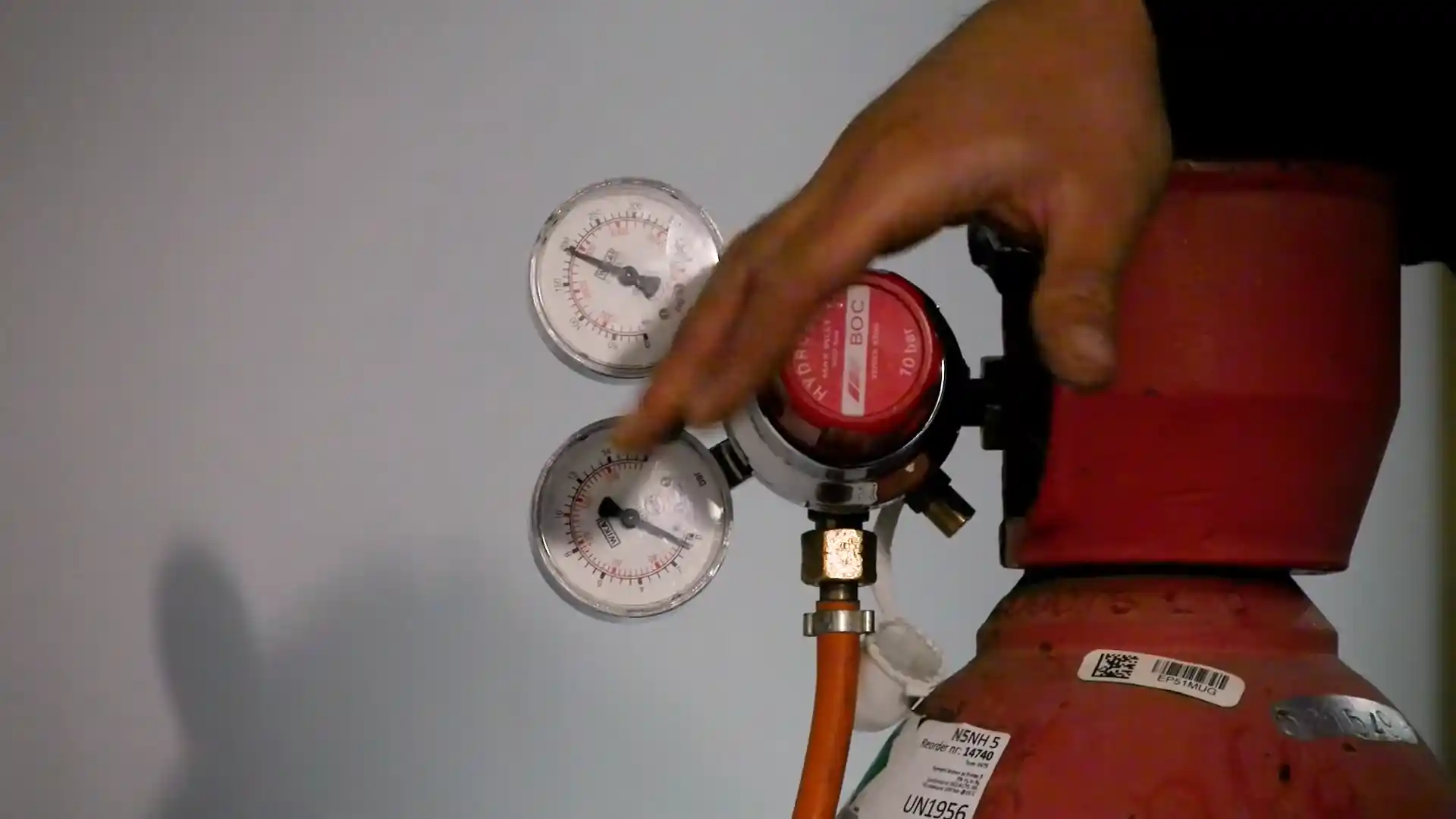
Helium is the second-smallest atom there is. Introduced into an isolated, drained line under modest pressure, it exits through any breach that exists, no matter how fine, and then does what light gases do: rises. Up through water, up through soil, up through the hairline gaps in concrete, until it reaches the surface directly above its escape point.
A handheld sniffer sensitive to a few parts per million samples along the pipe route, and the reading spikes where the gas surfaces. The leak has announced its own address, in a signal that did not exist in nature a minute earlier, so false positives have nowhere to come from.
Completely Safe, Worth Saying Twice
The tracer mix is inert and harmless: typically nitrogen carrying a helium fraction, or industry-standard formulations of similar character. It does not burn, react, or linger, and it dissipates to the open air minutes after the test. The line gets flushed back into normal service afterward with nothing left behind. Households sometimes hear gas and worry, and the worry deserves this plain answer: this is balloon-and-hospital helium doing detective work, not anything hazardous.
The method is standard practice across water utilities and pool professionals worldwide for exactly this combination of sensitivity and safety.
The Cases That Route Here
Tracer gas earns its slot on the truck for a specific casebook. Plastic pipe, which carries no acoustic signal worth trusting, is the headline client, and that makes pool line locates the method's busiest local application: long buried PVC runs under decks, pressure-tested guilty but acoustically mute. Silent seeps under slabs, lines already drained by their own failure, and deep runs where every sound method attenuated away round out the list.
It also breaks ties when two methods disagree. A gas spike above a marked point settles the argument the way instruments should: with separate physics.
How a Gas Locate Runs, Step by Step
The sequence is deliberate. The suspect line gets isolated and drained, because gas hunting works best in an empty pipe. The charge goes in at controlled low pressure, sized to the line. A waiting interval lets the gas migrate through the breach and climb, longer for deeper pipe and denser cover. Then the sniffer samples along the traced route in a slow grid, and the operator logs concentrations until the spike localizes.
Route knowledge matters here as everywhere, so gas locates lean on the same line tracing that aims the acoustic work, sonde-driven when the pipe is plastic. The mark that results gets the same photographic documentation and confidence statement as any other locate.
What You Can Do Before a Gas Visit
Two small preparations speed the day. Clear access to the line's endpoints, the equipment pad for a pool or the cleanout and valve for a house line, since the charge goes in there. And plan for the line to sit out of service for the visit; a pool skips a filter cycle, a house line pauses for the test window. The gas does its climbing on its own schedule, and the visit is built around letting it.
Patience as a Feature, Not a Flaw
Gas locates run slower than listening surveys, and the slowness is the price of their reach. Migration takes time through El Monte's layered river soils, and rushing the wait is how spikes get missed. Owners around North El Monte with veteran pools learn the rhythm: an unhurried afternoon that ends a mystery which had eaten a season of topping-up.
When your leak has already defeated a method or two, say so at (626) 898-6169 and the gas rig gets scheduled with the right time block. And if you are staring at a pool that pressure-tested guilty on a line no one can hear, skip the middle steps: (626) 898-6169, ask for the helium.
When the leak goes silent, we send in the atom that cannot keep a secret.
✆ (626) 898-6169Tracer Gas Questions From El Monte
Is the tracer gas safe for my pipes and drinking water?
Completely. The mix is inert, food-industry-grade gas that neither reacts with pipe materials nor leaves residue. After the locate, the line gets flushed and returned to service exactly as it was. The same approach is used by water utilities on municipal mains, which is about as strong an endorsement of safety as plumbing offers.
Why not just use tracer gas on every leak?
Cost and time. Listening and thermal methods locate most pressurized leaks in a fraction of the setup, since they need no draining, charging, or migration wait. Gas is the specialist for the cases those methods cannot reach: plastic, silence, and depth. Using the fast tools first and the gas when the casebook says so keeps locates affordable.
How precise is the mark from a gas locate?
Typically within a foot or two, tightened by sampling in a finer grid once the first spike appears, and by longer migration waits on deep lines. Soil layering can drift the surfacing point slightly sideways, which the operator accounts for by reading the spike's shape rather than a single peak. Ask about your specific line at (626) 898-6169.