Thermal Method · Infrared Scanning · El Monte
Thermal Imaging Leak Detection in El Monte & Pasadena, CA
Everything in your house glows in light we cannot see, and wet material glows differently. Moisture cools a surface as it dries. A hot water leak warms whatever it touches. An infrared camera turns both into shapes on a screen: the plume above a hot slab line, the cool bloom of a wet stud bay, the trail a ceiling leak walked before it dripped.
What the Camera Actually Sees
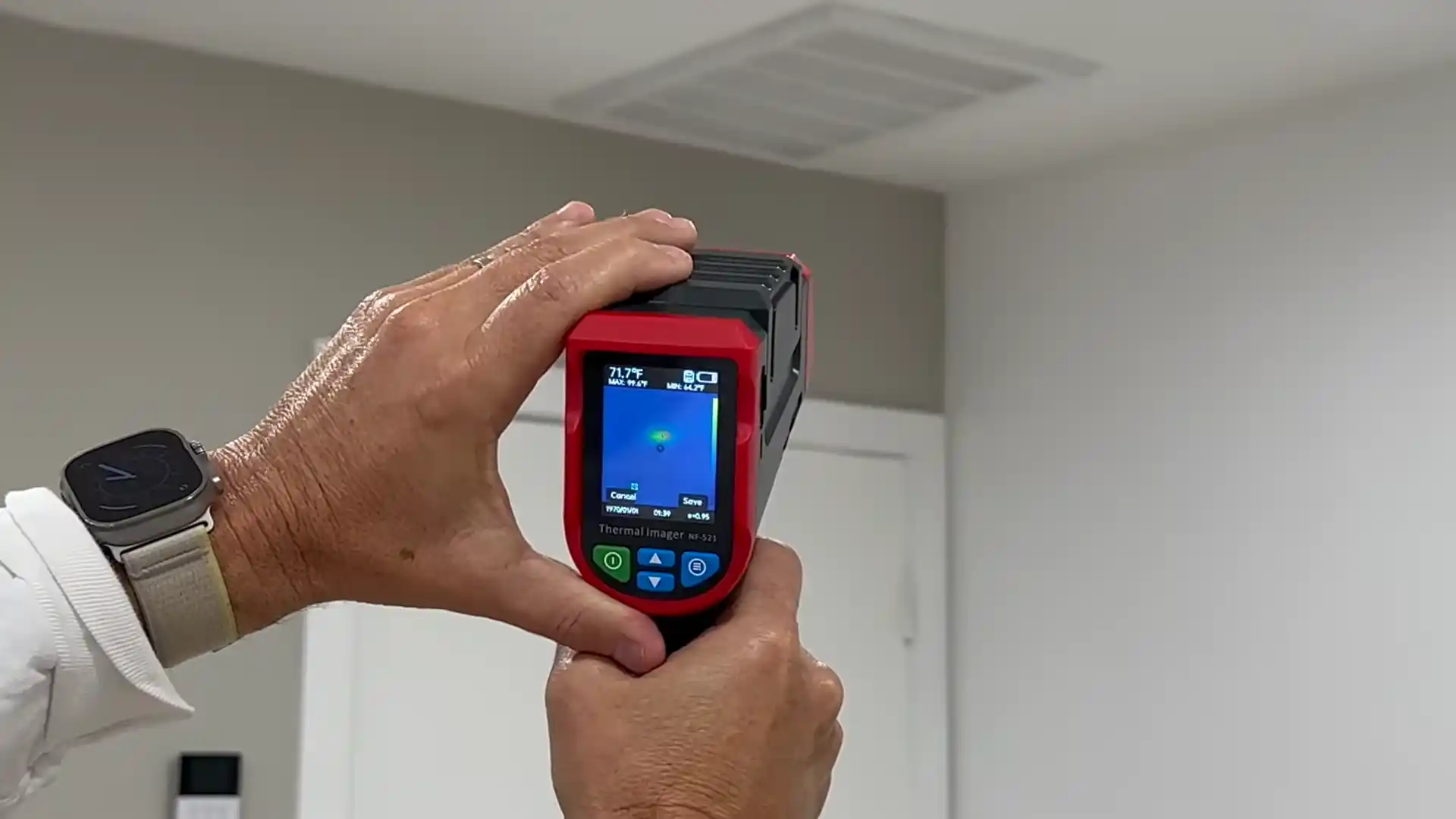
An infrared camera does not see water. It sees surface temperature, in fine gradations, painted as color. Water reveals itself through what it does to temperature. Damp drywall reads colder than its dry neighbors as moisture evaporates. Hot supply water warms a stripe up a wall or a patch across a slab. And soaked material holds its temperature, lagging the room as the day warms and cools around it.
Reading those patterns is interpretation, not magic. Ducts, studs, sun-heated exterior walls, and drafts all paint shapes too, and the operator's job is telling plumbing stories from architectural ones.
The Confirmation Rule: Camera Plus Meter
Every thermal anomaly on our jobs meets a moisture meter before it gets believed. The camera proposes; the meter confirms. A cold streak that meters dry is a draft or a duct and gets dismissed. One that meters wet is evidence, mapped and photographed. This two-step discipline is why thermal work here does not produce the false-alarm wall openings that give the technology a mixed reputation.
The pairing runs through everything the method touches, from wall scans to the upstream tracing of ceiling stains, where the camera follows the wet corridor back toward its source.
Where Infrared Earns Its Keep Locally
Three El Monte situations play to the camera's strengths. Hot-side slab leaks, where the warm plume through the concrete localizes the search before a microphone ever touches the floor. Wall and ceiling moisture, where the wet zone's shape and direction narrow a whole room to one stud bay. And post-repair verification, where a rescan proves the cavity actually dried before the drywall closes, a step that separates a finished job from a future mold call.
Across the 91732 side and the rest of the city, hot-slab scans in particular save real time: the camera reads a whole floor in minutes and hands acoustic a corridor instead of a field.
What Thermal Cannot Do, Stated Upfront
The camera reads surfaces only. It cannot see through walls, into pipes, or under intact flooring to any depth; it sees the temperature consequences that reach the visible face. Cold-water leaks under thick slabs may show nothing until enough moisture migrates up. Saturated insulation can mask patterns. And a room recently heated, cooled, or sunlit carries thermal noise that takes experience to read past.
So thermal is a narrowing tool and a verifying tool, rarely the whole locate by itself. It aims the microphone, confirms the suspicion, and proves the drying, and in that role it is quietly indispensable.
Best Hours for a Clean Scan
Timing helps the camera. Early morning scans beat afternoon ones on sun-heated rooms, since a wall baked by west light hides a wet zone behind warm noise. Steady indoor temperature helps too, so we may ask that the AC hold one setting for an hour before the visit. None of this is fussy for its own sake. A calm thermal background is what lets a one-degree wet patch stand out instead of drowning.
The Scan Visit, Start to Finish
A typical scan covers the suspect rooms in under an hour. The camera passes from angles that control for sun and drafts. The meter confirms every anomaly. Photos pair each thermal image with its visible-light twin. You get the images, the meter readings, and the interpretation in writing, whether the verdict is a marked leak, a cleared wall, or a recommendation to cross-check with another method.
Scans book same-day inside the city at (626) 898-6169, and they pair naturally with acoustic work when a live pressurized leak is already confirmed. A warm patch of floor underfoot tonight is a textbook reason to call (626) 898-6169 tomorrow morning.
The heat signature is already on your wall. The camera just makes it visible.
✆ (626) 898-6169Infrared Scanning Questions From El Monte
Can thermal imaging see pipes inside my walls?
It sees their temperature effects, not the pipes themselves. A hot line in use paints a warm trace on the wall surface; a leak paints a wet-cool bloom. Cold lines at room temperature and dry cavities show little. That is why the camera works as evidence-of-consequence, always confirmed by a moisture meter before anything gets opened.
Does the scan work on a slab floor?
Hot-side slab leaks are one of its best uses: the escaping hot water warms the concrete above it, and the plume shows clearly through most flooring. Cold-side slab leaks are harder, since they may produce little surface signature until moisture migrates upward. Those cases lean on acoustic and isolation methods, with thermal as the cross-check.
Is an infrared scan worth it if I already know roughly where the leak is?
Usually yes, because roughly is expensive. A scan converts a suspect wall into one marked stud bay and often reveals that the moisture extends further than the visible stain suggests, which changes the drying plan. It is quick, cuts nothing, and the images document conditions for insurance. Book one alongside the repair visit at (626) 898-6169.