Ultrasonic Method · High Frequency · El Monte
Ultrasonic Leak Detection in El Monte & Pasadena, CA
Some leaks whisper above human hearing. A fine pressurized escape emits its strongest sound up in the ultrasonic band, past 20,000 cycles per second. The pinhole just opening, the fitting seeping mist: both sing up there, where neither your ear nor a standard ground microphone is listening. Ultrasonic sensors live in exactly that band.
The Frequency Gap This Method Fills
Leak sounds spread across a spectrum, and size decides the pitch. Big breaches rumble low: soil surge, water rush, the frequencies ground microphones love. Tiny breaches sing high: turbulence through a pinhole generates its energy in the ultrasonic range, thin and directional, gone before it travels far. Standard listening gear, tuned for the low end, can walk right over a fine leak and hear nothing.
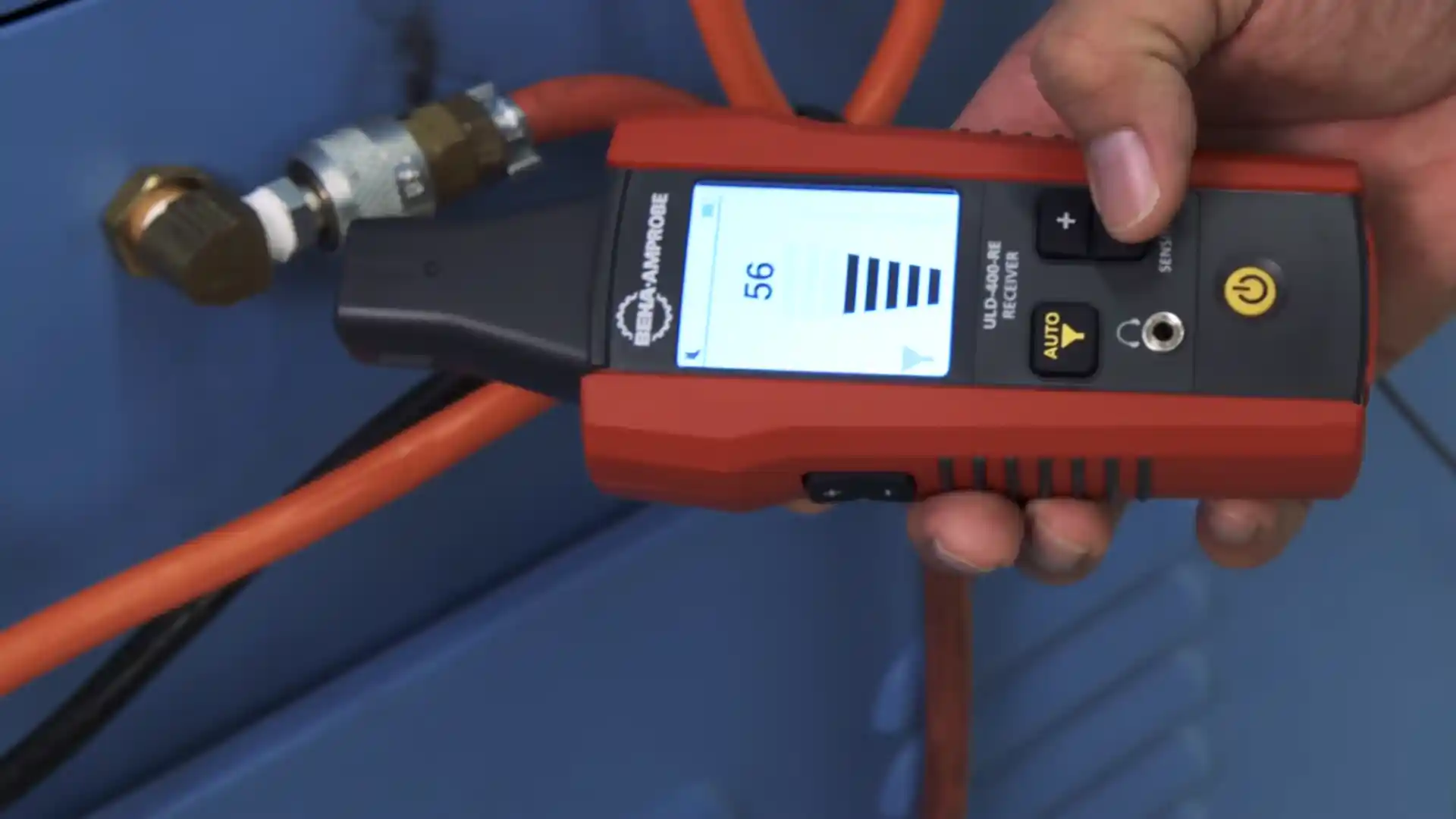
Ultrasonic receivers translate that high band down to audible tones in the operator's headset, and suddenly the whisper has a direction and a strength that can be followed.
Small, Fresh, and Close: The Ideal Targets
The method's sweet spot is the leak still in its youth. A copper pinhole just breaking through, a compression fitting misting invisibly, a valve packing seeping under pressure: all strong ultrasonic emitters and all weak conventional ones. Because high frequencies fade fast with distance and barriers, the method shines closest to the source, in accessible spaces, at fixtures and equipment, along exposed runs, and through modest cover.
That youth bias has real value in this city, where the copper cohort produces pinholes on schedule. Catching one at the mist stage, before the stain, is the cheapest version of that whole story, the version told in full on our pinhole page.
Directionality: The Feature That Feels Like a Trick
Ultrasound behaves more like a beam than a rumble. It reflects off surfaces, shadows behind obstacles, and grows sharply louder as the sensor points at the source. The operator exploits that: sweeping a wall or an equipment bay, watching the meter spike on-axis, and triangulating a source to a small patch without touching anything. It is the same reason the technology finds compressed-air leaks in factories, applied to water under pressure.
The directional sweep pairs naturally with the rest of the toolkit, flagging a hot zone that thermal and moisture metering then confirm, all inside the no-cutting discipline of our non-invasive approach.
Limits, Because Every Band Has Them
What makes ultrasound precise also keeps it short-ranged. High notes fade fast through soil and mass, so deep slab and buried work stays low-frequency territory. Gravity drains, unpressurized lines, and soaked-out old leaks emit little in any band. And stray ultrasound exists too. Some electronics and even rustling leaves chatter up there, which is where the operator's filters and ear separate signal from static.
The practical rule: ultrasonic is a scalpel for small pressurized leaks at close range, not a shovel for deep ones. Jobs get the scalpel when the symptoms fit, and the low-frequency gear when they do not.
Try the Nighttime Ear Test First
Your own ears can scout for this method. Pick the quietest hour of the night, shut every fixture, and stand near the walls that carry pipe. Listen for a thin, steady hiss, higher than a hum, that does not change when you move your head far away but sharpens as you lean toward one spot. You are hearing the audible skirt of an ultrasonic emitter. Note the spot; the sensor will thank you for the head start.
Where It Slots Into an El Monte Locate
Expect the ultrasonic sensor when the meter proves a loss but the ground mic finds no peak. It comes out when a fixture or manifold area is suspect, when a wall reads marginal, and during equipment-room surveys where fittings crowd together. Around the Garvey corridor and everywhere the mid-century copper runs, it is the early-warning instrument for the next pinhole generation.
It rides on the same truck as everything else, so requesting it is as simple as describing your symptoms to (626) 898-6169. A hiss you can almost hear near a fixture at night is precisely its kind of case: (626) 898-6169.
The smallest leaks sing the highest notes. We carry the receiver that hears them.
✆ (626) 898-6169Ultrasonic Method Questions From El Monte
How is ultrasonic different from regular acoustic detection?
Frequency band and range. Ground microphones listen low, where big leaks rumble and sound travels far through slab and soil. Ultrasonic sensors listen above 20 kHz, where small fresh leaks emit strongest but the signal fades quickly with distance. They are siblings, not rivals: the survey picks the band that matches the suspected leak's size and depth.
Can ultrasonic find a leak behind my wall without opening it?
Often, when the leak is pressurized and reasonably close to the surface. The directional sweep localizes the strongest emission to a patch of wall, and thermal plus moisture metering confirm before anything is cut. Deeper or older leaks that have stopped misting lean on the other methods, and the visit carries them all.
My water bill rose but every test so far found nothing. Is this the next step?
It is one of them, and a good one. A loss the meter proves but low-frequency listening cannot place often means a small, fresh escape emitting up-band. The ultrasonic sweep covers fixtures, manifolds, and accessible runs, and pairs with isolation testing to corner it. Bring the history of what has been tried to (626) 898-6169 and the sequence picks up from there.